


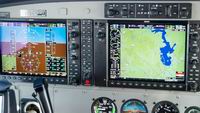
Garmin G1000 EFIS (below) |
 |
Cessna 208 Caravan |
 |
Cessna 208 Caravan Landplane (above) |
 |
General
The course is avialble for land and seaplane versions of the Cessna 208 Caravan [Cessna SET]
Only available to UK licence holders
Pre-Course Entry Requirements
Hold at least a PPL(A) or a pilot licence accepted in accordance with Part FCL
Be at least 17 years of age
Hold a valid class 1 or 2 medical certificate
Hold at least a valid ELP at level 4
Theoretical Knowledge Training
The Cessna SET (C208) land theoretical knowledge training syllabus is 5 hours and includes:
Detailed listing for Aeroplane Structure and Equipment, Normal
Operation of Systems and Malfunctions
Limitations
Performance, Flight Planning and Monitoring
Load and Balance and Servicing
Emergency Procedures
The Cessna SET (C208) sea theoretical knowledge training syllabus is 8 hours and icludes (see notes 1, 2):
#Detailed listing for Aeroplane Structure and Equipment, Normal
#
Operation of Systems and Malfunctions
#
Limitations
#Performance, Flight Planning and Monitoring
#Load and Balance and Servicing
#Emergency Procedures
Techniques for Take-off, Landing, Taxiing and Mooring
*Float Construction Methods and Characteristics including Pre-Flight Preparation
*Symbols and Abbreviations used in Admiralty Charts and Plans
*The Regulations for Preventing Collisions at Sea
*International Association of Lighthouse Maritime Buoyage - Region A
*Knowledge of Tides and Tidal Definitions in General Use
Notes:
1. The holder of a SEP (Sea) Class Rating is credited with the starred (*) items in the Cessna SET (C208) sea theoretical knowledge training syllabus
2. The holder of a Cessna SET (C208) land Class Rating is credited with the hashtag (#) items in the Cessna SET (C208) sea theoretical knowledge training syllabus
Flight Training
The flight training for a Cessna SET (C208) sea class rating shall include at least 8 hours of dual flight instruction
The flight training for a Cessna SET (C208) land class rating shall include at least 5 hours of dual flight instruction
Theoretical Knowledge Examination Cessna SET (C208) sea only
Pass a written examination consisting of 30 multiple choice questions covering aspects of seamanship and seaplane operations. The pass mark is 75%. The subjects covered include:
Symbols and abbreviations used in Admiralty charts and plans which are of importance to seaplane and amphibian pilots
The regulations for preventing collisions at sea
Lights and shapes to be carried by ships and aeroplanes
Sound and light signals of distress (ships)
International Association of Lighthouse Maritime Buoyage - Region A
Knowledge of tides and tidal definitions in general use
Seaplane operations
Water characteristics and conditions
Floats and hulls
Principles of seaplanes on water and in flight
Cessna SET Class Rating Skill Test/Proficiency Check
The applicant shall pass the skill test within a period of 6 months after commencement of the class or type rating training course and within a period of 6 months preceding the application for the issue of the class rating
Before a skill test for the issue of the Cessna SET (C208) Sea Class Rating is taken, the candidate shall have passed the required theoretical knowledge examination
In any case, the theoretical knowledge instruction shall always have been completed before the skill test is taken
The candidate for a skill test shall be recommended for the test by the organisation/person responsible for the training, once the training is completed. The training records shall be made available to the examiner. The skill test/proficiency check schedule is given below
Section 1 Departure
Pre-flight including: Documentation, NOTAM, Mass and Balance, Weather briefing
Pre-start checks: External and Internal
Engine Start-up and Shutdown: Normal and Malfunctions
Taxiing
Step Taxiing (seaplane only)
Mooring: Beach, Jetty/Pier, Buoy (seaplane only)
Engine off sailing (seaplane only)
Pre-departure checks: Engine run-up (if applicable)
Take-off procedure: Normal with Flight Manual flap settings, Crosswind (if conditions available)
Climbing: Turns onto headings, Level off
ATC liaison - Compliance, R/T procedure
Section 2 Airwork (VFR)
Straight and level flight at various airspeeds including flight at critically low airspeed with and without flaps (including approach to Vmca when applicable)
Steep turns: 360º left and right at 45º bank
Stalls and recovery:
(i) Clean stall
(ii) Approach to stall in descending turn with bank with approach configuration and power
(iii) Approach to stall in landing configuration and power
(iv) Approach to stall, climbing turn with take-off flap and climb power (SE only)
Handling using autopilot and flight director (may be conducted in Section 3) (if applicable)
ATC liaison - Compliance, R/T procedure
Section 3 En-Route Procedures (VFR)
Flight plan, dead reckoning and map reading
Maintenance of altitude, heading and speed
Orientation, timing and revision of ETAs
Use of radio navigation aids (if applicable)
Flight management (flight log, routine checks including fuel, systems and icing)
ATC liaison - Compliance, R/T procedure
Section 4 Arrival and Landings
Aerodrome arrival procedure
Normal landing
Flapless landing
Crosswind landing (if suitable conditions)
Approach and landing with idle power from up to 2000 ft above the water (SE only)
Go-around from minimum height
Glassy water landing (seaplane only)
Rough water landing (seaplane only)
ATC liaison - Compliance, R/T procedure
Section 5 Abnormal and Emergency Procedures
(This section may be combined with sections 1 through 4)
Rejected take-off at a reasonable speed
Simulated engine failure after take-off (SE only)
Simulated forced landing without power (SE only)
Simulated emergencies: Fire or smoke in flight, System’s malfunctions as appropriate
Engine shutdown and restart at a safe altitude if performed in an aeroplane (ME only)
ATC liaison - Compliance, R/T procedure
Section 6 Simulated Asymmetric Flight
Not applicable
Validity
24 months
Privileges
The privileges of the holder of a class or type rating are to act as pilot on the class or type of aircraft specified in the rating
Revalidation
Single-pilot single-engine turbo-prop aeroplanes. For revalidation of single-engine turbo-prop class ratings applicants shall pass a proficiency check on the relevant class in accordance with Part FCL Appendix 9 with an examiner, within the 3 months preceding the expiry date of the rating
Note: The proficiency check for the revalidation of a single-pilot single-engine aeroplane class rating may be combined with the proficiency check for the revalidation of a EIR or IR(A)
Renewal
(b) For the renewal of a class or type rating, applicants shall comply with all of the following:
(1) in order to determine whether refresher training is necessary for the applicant to reach the level of proficiency to safely operate the aircraft, they shall undergo an assessment at one of the following:
(i) at an ATO
(ii) at a DTO or at an ATO, if the expired rating concerned a non-high-performance single-engine piston class rating, a TMG class rating or a single-engine type rating for helicopters referred to in point DTO.GEN.110(a)(2)(c) of Aircrew Regulation Annex VIII
(iii) at a DTO, at an ATO or with an instructor, if the rating expired no more than 3 years ago and the rating concerned a non-high-performance single-engine piston class rating or a TMG class rating
(iv) at an EBT operator that is specifically approved for such refresher training
(2) if deemed necessary by the organisation or the instructor providing the assessment in accordance with point (1), they shall complete refresher training at that organisation or with that instructor
(3) after complying with point (1) and, as applicable, point (2), they shall pass a proficiency check in accordance with Part FCL Appendix 9 or complete EBT practical assessment in accordance with Part FCL Appendix 10. That EBT practical assessment may be combined with the refresher training specified in point (2). By way of derogation from points (b)(1), (b)(2) and (b)(3), pilots holding a flight test rating issued in accordance with point FCL.820 who were involved in the development, certification or production flight tests for an aircraft type and have completed either 50 hours of total flight time or 10 hours of flight time as PIC in test flights in that type during the year prior to the date of their application, shall be entitled to apply for the revalidation or renewal of the relevant type rating. Applicants shall be exempted from the requirement in points (b)(1) and (b)(2) if they hold, and are entitled to exercise the privileges of, a valid rating for the same class or type of aircraft on a pilot licence issued by a third country in accordance with Annex 1 to the Chicago Convention
Notes:
'Evidence-Based Training (EBT) practical assessment' means a method for assessing performance that serves to verify the integrated performance of competencies and takes place in either a simulated or an operational environment
'Evidence-Based Training (EBT) operator' means an organisation that is holding an Air Operator Certificate (AOC) in accordance with Annex III (Part-ORO) to Regulation 965/2012 and that has implemented an EBT programme approved by the UK CAA, in accordance with the provisions of that Regulation
'Evidence-Based Training (EBT) programme' means a pilot assessment and training programme in accordance with point ORO.FC.231 (evidence-based training) of Annex III (Part-ORO) to Regulation 965/2012
References
How To Fly Floats by J J Frey
Part FCL including AMC, GM and Appendicies
Seaplane Operations by Dale DeRemer and Cesare Baj
Flying A Floatplane by C Marin Faure
International Regulations for the Preventing of Collisions at Sea by Royal Yachting Association
ICAO Annex 2 Rules of the Air Chapter 3 Paragraph 3.2.6 Water Operations
ICAO Annex 6 Parts 1 and 2 Operations of Aircraft Chapter 6, Appendix to Chapter 6 Lights to be Displayed by Aircraft
FAA Flight Training Handbook - Seaplane Operations (Free download)
Transport of Canada - Instructor Guide Seaplane Rating (Free download)
Nautical Almanac (This publication can be found in most Libraries under Reference Books)
Symbols and Abbreviations used on Admiralty Charts - Chart 5011
IALA Maritime Buoyage System - ANP735
A Seaman's Guide to the Rules of the Road by Morgan Technical
Learn the Nautical Rules of the Road by Paul Boissier
Caravan Cessna's Swiss Army Knife with Wings! by J D Lewis and LeRoy Cook