


General
All aeroplane, airship, powered lift aircraft and helicopter pilots, flight navigators and air traffic controllers need to hold valid language proficiency endorsement for radio communication. Each National Aviation Authority (NAA) can only endorse english language proficiency levels on the licences that they issue e.g. UK CAA will not accept another NAA ELP level
Your language skills will be rated on a scale of 1 to 6 (as defined by ICAO) and you must achieve a minimum of level 4. If you are graded at level 4 or 5 you will need to be retested regularly. If you achieve level 6 you will not need to be retested unless you are an ATCO. Your language proficiency will be endorsed on your licence by your NAA with a validity date.
You will need to do the retest as follows:
Scale |
EASA | UK |
ICAO |
||
Pilot |
ATCO |
Pilot |
ATCO |
|
Level 4 |
every 4 years from date of assessment |
every 3 years from date of assessment |
every 3 years from date of assessment |
|
Level 5 |
every 6 years from date of assessment |
every 6 years from date of assessment |
||
Level 6 |
no further assessment |
every 9 years from date of assessment |
no further assessment |
|
If you are graded below a level 4, you will not be able to get a licence that includes radiotelephony privileges. This also applies to national licences. In the UK, you need to obtain a Flight Radiotelephony Operator’s Licence (FRTOL) to use radio communications equipment, and to be able to use this you must have a language endorsement on your licence at level 6, or have a valid proficiency if you achieved a level 4 or 5.
Requirements
In order to get the endorsement, you will need to demonstrate that you are able to do the following:
- Communicate effectively voice-only and face-to-face
- Communicate on common and work-related topics with accuracy and clarity
- Use appropriate communicative strategies to exchange messages and to recognise and resolve misunderstandings in a general or work-related context
- Be able to use language effectively in a difficult or emergency work-related situation or communication task, that you have not encountered before
- Speak in an accent or dialect that can be understood
If you hold and instrument rating (IR), or en route instrument rating (EIR) [basic instrument rating (BIR) - EASA only] you must be able to demonstrate your English language proficiency to a level that will allow you to:
- understand all the relevant information for all phases of flight, including preparation
- use radiotelephony in all phases of flight, including emergencies
- communicate with crew members during all phases of flight, including preparation
Assessment Methods UK CAA Only
Informal assessments may be conducted during existing checking or training activities, including rating issue or revalidation, line training, operator line checks or proficiency checks, through the FRTOL practical test, an interview or oral interaction with a flight or radiotelephony examiner
During the UK CAA FRTOL Practical Test
A UK approved FRTOL examiner holding a level 6 proficiency in English can assess you during your practical test for the UK FRTOL. If your language level does not meet a level 6 then you will need to go to an expert assessor, such as a CAA approved language school
During a Flight/Simulator Skill Test or Proficiency Check or Assessment of Competence
Examiners holding FE, TRE, SFE, CRE, IRE or FIE privileges granted by the UK CAA and who hold Level 6 English Language Proficiency can currently conduct assessments for first-language speakers with native or native-like proficiency as well as second- or foreign-language speaker with a high level of proficiency and, where appropriate, award level 6 proficiency. If your language level does not meet a level 6 then you will need to go to an expert assessor, such as a CAA approved language school or an examiner who has completed specialist language assessor training for formal assessment
Through a Specialist Language School
You need to make sure the language school is approved by the UK CAA. Details of these organisations are published in UK CAA Standards Document 31
At an ATO
A number of Approved Training Organisations (ATO) will offer language training modules as part of their overall training package, and if approved to do so by the UK CAA the ATO will be able to assess your language proficiency
English Language Proficiency Assessments for UK CAA
Assessing English Language Proficiency (ELP) to meet the requirements for flight crew licensing the assessment test can be carried out in 3 ways:
- Through UK CAA approved ELP testing organisations which assess language proficiency by means of a formal assessment test (for level 4 - 6)
- Informal assessment by flight or FRTOL examiners who have completed specialist language assessor training (for level 4 - 6) (currently unavailable in UK but being developed)
- Informal assessment by flight or FRTOL examiners who themselves have been assessed as level 6, seek to exercise the privilege of verifying at level 6 only are not required to complete a formal specialist language assessor training course
Examiners without a professional background in language assessment should consider specialist language assessor training. There are a number of UK established providers of aviation English training that have approval for specialist language assessor courses e.g. Lenguax. Examiners who have completed a specialist assessor course, approved by the UK CAA, will receive authorisation to conduct language assessments for a period of three years, which may be renewed
All English speakers who are unable to satisfactorily demonstrate Level 6 proficiency to an approved examiner; as being a first-language speaker with native or native-like proficiency as well as second- or foreign-language speaker with a high level of proficiency must be referred to a UK CAA Approved Language Assessment Centre or an examiner who has completed specialist language assessor training
Informal assessments must no longer to be used when candidates have previously demonstrated Language Proficiency at either level 4 (Operational) or level 5 (Extended) in a formal assessment.
Persons holding a level 4 or 5 assessment issued by the UK CAA must attend a UK CAA Approved Language Assessment centre (see UK CAA Standards Document 31) or an examiner who has completed specialist language assessor training to renew or upgrade their assessment.
Only those who were granted an automatic level 4 by the UK CAA in 2008 are exempt from this requirement. To establish if you are such an individual check your pilot licence in 'Section XIII Remarks' you will see the following words 'Language Proficiency: English'. See example below.
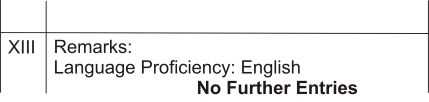
Please note that an invalid language proficiency assessment invalidates an FRTOL and will delay any subsequent licence request
Level 6 (Expert) Guidance For Examiners
Examiners should treat speakers who use English as their first-language as 'probable expert users'. However, examiners should be aware that a 'first-language English speaker' does not necessarily mean 'level 6 (Expert)' user. Speakers who use English as their first-language may lack the vocabulary to discuss certain themes or may speak with a regional accent that is an impediment to intelligibility for those from outside that region. They may fail to use appropriate language or may not interact effectively; consequently should not be assessed as level 6 (Expert)
Speakers who use English as their first-language who fail to demonstrate proficiency in all aspects of the Level 6 descriptors in the ICAO Rating Scale should not be assessed as level 6 (Expert)
Attainment of level 6 should be considered as being beyond the realistic expectations of most second- or foreign-language learners (reference ICAO Doc 9835)
Level 6 proficiency is not an essential requirement for successful aeronautical communication. It has a very wide coverage since it is intended to account for most first-language speakers with native or native-like proficiency as well as second- or foreign-language speakers with a high level of proficiency
If a candidate is potentially considered to be a level 6 speaker and is to be evaluated through an informal assessment, this must be supported by evidence (see note) of an individual's linguistic history which must be retained by the examiner as set out in FCL.1030 (c). The Examiner must submit an examiner report form, or a CAA5012 in the case of a stand-alone language assessment, to the UK CAA
Note:
Records of supporting evidence to be retained by the examiner must include relevant details of:
- place of birth and early residence
- the language(s) used during childhood in the family, in the community and in education
- any long periods of residence (with proven participation) in communities where the language is used socially, professionally or in education
- extended periods of language study or higher education diplomas
Informal assessment may proceed only if the examiner's initial evaluation indicates that the supporting evidence is sufficient to support a subsequent application
Rating Scale for Level 6 (Expert)
The UK CAA wants to ensure that in all cases where an informal assessment of Level 6 (Expert Level) proficiency is undertaken, the exacting criteria specified in AMC 2 FCL.055 are consistently met before a rating is awarded:
Pronunciation
[Assumes a dialect or accent intelligible to the aeronautical community] |
Pronunciation, stress, rhythm, and intonation, though possibly influenced by the first language or regional variation, almost never interfere with ease of understanding |
Structure
[Relevant grammatical structures and sentence patterns are determined by language functions appropriate to the task] |
Both basic and complex grammatical structures and sentence patterns are consistently well controlled |
Vocabulary |
Vocabulary range and accuracy are sufficient to communicate effectively on a wide variety of familiar and unfamiliar topics. Vocabulary is idiomatic, nuanced and sensitive to register |
Fluency |
Able to speak at length with a natural, effortless flow. Varies speech flow for stylistic effect, for example to emphasise a point. Uses appropriate discourse markers and connectors spontaneously |
Comprehension |
Comprehension is consistently accurate in nearly all contexts and includes comprehension of linguistic and cultural subtleties |
Interactions |
Interacts with ease in nearly all situations. Is sensitive to verbal and non-verbal cues, and responds to them appropriately |
To receive a level 6 rating, a candidate must demonstrate all aspects of the level 6 descriptors in the rating scale during the assessment. Examiners must be in no doubt that a candidate is an expert speaker
In cases where the examiner has doubts about the level of attainment in any element of the assessment, then no language proficiency level should be recorded, and the candidate referred to a UK CAA approved ELP Testing Organisation for formal assessment
References
Aircrew Regulation Part FCL:
FCL.055 Language proficiency - the regulation
AMC1 FCL.055 Language proficiency - the assessment
AMC2 FCL.055 Language proficiency - the rating scale
AMC3 FCL.055 Language proficiency - specific requirements for holders of an IR or (EIR UK only)(BIR EASA only)
Appendix 2 - Language proficiency rating scale - expert, extended and operational level
ICAO:
Doc 9835 - Manual on the Implementation of ICAO Language Proficiency Requirements